
 with Meridian Tenant Advisors
Kestrel Motion
Real Estate Roadmap
What your first 12,000 square feet will cost, where to find it, and the path from a robotics lab to a national logistics footprint.
A 12,000 to 24,000 SF lab after the raise, and a full-scale warehouse behind it.
Once the round closes, roughly six weeks out, Kestrel Motion needs space to develop and test its robots as a working mock warehouse, then a facility built for operations. Here is the requirement as we understood it.
Route 128 North, the I-495 belt or Metro West, or greater Pittsburgh, where some engineers may be based. The Pittsburgh decision was a couple of weeks out as of our call.
Favorable triple net and good tenant improvements. Second-generation space; development is off the table near term.
Phoenix, Houston, Columbus, Charleston and Chicago's I-80 corridor, with a preference for keeping real estate off the balance sheet.
Five things to know before you sign anything.
Route 128 North holds the region's sublease supply.
Route 128 North is one of the tightest flex markets around Boston at 5.8% vacancy, yet it carried 1.3M SF of sublease availability in Q1 2026, about 38% of the suburban total. It belongs on the list even though it is not the cheapest option.
A short sublease and good TI pull in opposite directions.
Subleases are normally delivered as-is, and landlords tie improvement dollars to multi-year direct leases. The practical answer is to take over space someone already built out; several labs and clean rooms are on the market now.
Twelve months is a balance-sheet line.
A lease of 12 months or less can stay off the balance sheet under ASC 842. A renewal you are reasonably certain to exercise counts toward the term, so keeping the lab after the big move could bring it onto the books.
Most subleases on the market run one to three years.
Most subleases on the market have one to three years left. A 6 to 12 month deal is achievable, but it is a negotiation, not a listing you pick off a shelf.
The large facility clock starts now, and power sets the pace.
Moving into 275,000 to 450,000 SF by the end of 2027 means starting the search now, and no later than early 2027. A build-to-suit takes 16 to 26 months or more, and large transformer lead times have run over two years.
What 12,000 to 24,000 SF is asking, market by market.
Two views of rent: what live listings between 9,000 and 30,000 SF are asking today, and the market-wide average from Q2 2026 brokerage research. Small spaces ask more than the market average in I-495 Northwest, I-495 South and around Pittsburgh; on Route 128 North and in Metro West they sit at or below it.
| Market | Live listings, median ask | Q2 2026 market average | Vacancy | Drive from Cambridge |
|---|---|---|---|---|
| Route 128 North | $19.40 /SF/yr NNN (14) | $18.10–$20.40 | 5.8% | 20 to 30 min |
| I-495 Northwest | $15.25 /SF/yr NNN (9) | $13.40 (Billerica $13.85) | 9.8% (Billerica 8.9%) | 35 to 45 min |
| I-495 South | $11.50 /SF/yr NNN (4) | $9.95 (Mansfield) | 11.2% (Mansfield) | 45 to 55 min |
| Metro West | $16.75 /SF/yr NNN (11) | $18.20 · $14.60 Marlborough | 8.7% · 12.4% | About 35 to 50 min |
| Pittsburgh: Parkway West | $10.95 /SF/yr NNN (16) | $7.10 · flex $10.40 | 6.6% | Flight |
| Pittsburgh: North Hills | $12.50 /SF/yr NNN (7) | $9.85 · flex $13.20 | 7.6% | Flight |
| Pittsburgh: Parkway East | $10.50 /SF/yr NNN (10) | $6.95 · flex $11.10 | 9.6% | Flight |
Your all-in cost, by market.
Pick a market, a size and a term. Base rent uses the live-listing median; triple net uses what listings in each region publish. Both are editable, so you can plug in a quote the day you get one.
Excludes utilities, deposits, moving and fit-out. Boston-area sublease asks ranged from 21% below direct to above it.
Your all-in cost, by market.
Asking base rent plus triple net for 12,000 and 24,000 SF, before negotiation. The online version of this roadmap includes a calculator for any size, term and quote.
| Market | Base + NNN /SF/mo | 12,000 SF monthly | 12,000 SF, 12 months | 24,000 SF monthly | 24,000 SF, 12 months |
|---|---|---|---|---|---|
| Route 128 North | $1.62 + $0.48 | $25,200 | $302,400 | $50,400 | $604,800 |
| I-495 Northwest | $1.27 + $0.48 | $21,000 | $252,000 | $42,000 | $504,000 |
| I-495 South | $0.96 + $0.48 | $17,280 | $207,360 | $34,560 | $414,720 |
| Metro West | $1.40 + $0.48 | $22,560 | $270,720 | $45,120 | $541,440 |
| Pittsburgh: Parkway West | $0.91 + $0.25 | $13,920 | $167,040 | $27,840 | $334,080 |
| Pittsburgh: North Hills | $1.04 + $0.29 | $15,960 | $191,520 | $31,920 | $383,040 |
| Pittsburgh: Parkway East | $0.88 + $0.24 | $13,440 | $161,280 | $26,880 | $322,560 |
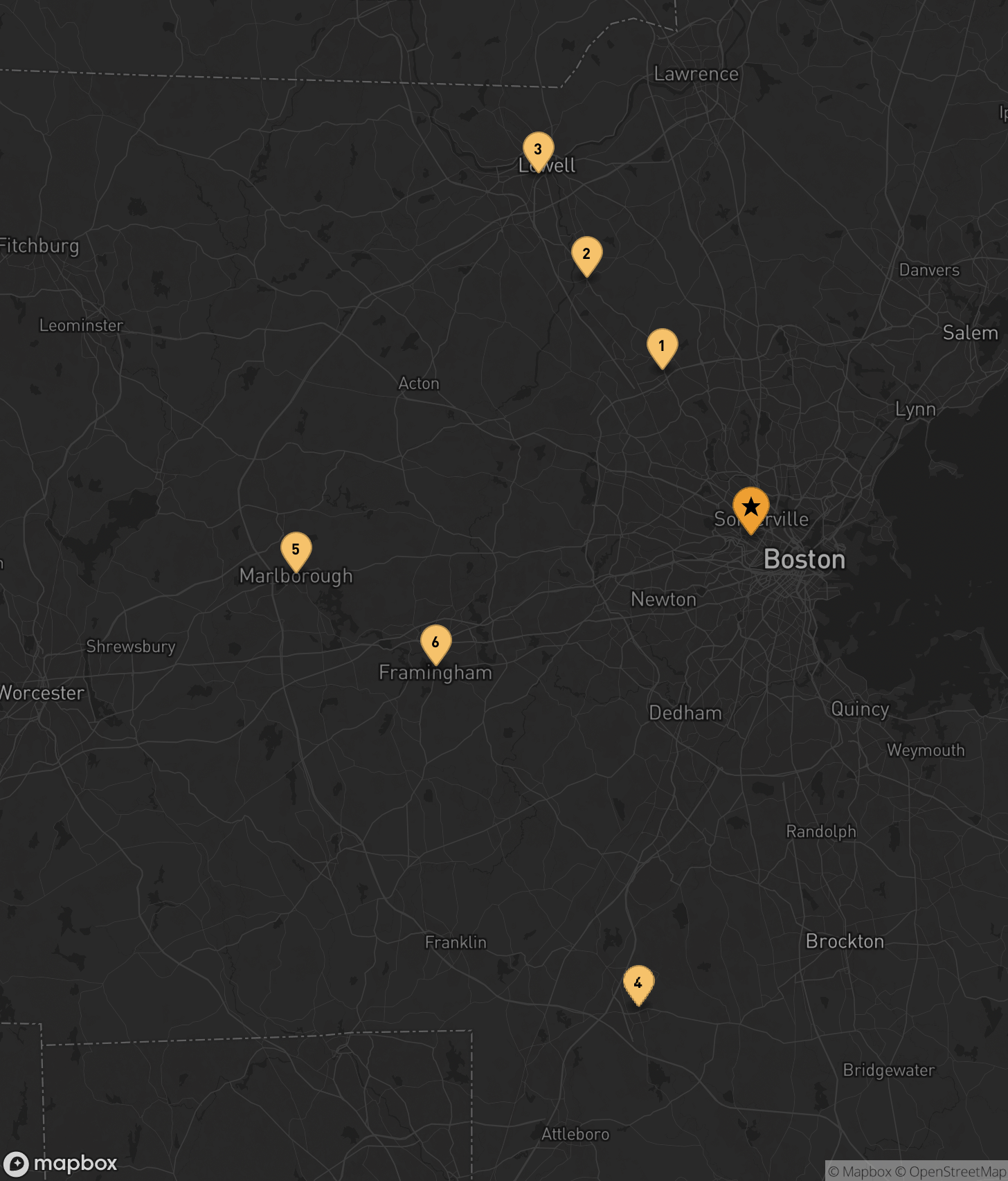
Every Boston option is within an hour of Cambridge.
The trade is simple: the further out along I-495, the lower the rent and the longer the drive from Cambridge.
- Route 128 North: most expensive and tightest, with the deepest sublease supply.
- I-495 Northwest: steady leasing from robotics and defense-tech users; about a quarter below Route 128 on asking rent.
- I-495 South: the lowest rents, but the market is built around big distribution boxes. Only four priced listings in your size range.
- Metro West: a mix of R&D and flex space; Marlborough and Hudson carry the highest flex vacancy in the region.
Pittsburgh is cheaper for a lab, but not by half.
Across all industrial space, Pittsburgh rents run well under half of suburban Boston's. At 12,000 SF the gap narrows, because small-bay space costs more everywhere. The real case for Pittsburgh is talent and ecosystem.
Robotics talent
Carnegie Mellon's Robotics Institute grants robotics M.S. and Ph.D. degrees, and the University of Pittsburgh adds a large engineering school a mile away.
A working ecosystem
Seegrid, Gecko Robotics and Carnegie Robotics are based in the region, and autonomy teams have clustered in the Strip District and Lawrenceville for a decade.
State support
Pennsylvania offers job creation tax credits and workforce training grants tied to new hires and job minimums, so they matter more at scale than for a lab.
The space exists. The terms are the work.
We reviewed 112 current listings between 9,000 and 30,000 SF across both regions. Four patterns shape how a search for Kestrel Motion should run.
9 subleases, 1 to 3 years left on most
Six around Boston and three around Pittsburgh. Expirations run from early 2027 to mid 2029. A 6 to 12 month deal means asking a sublandlord to split its remaining term, or finding one close to expiry: one Woburn sublease runs to July 2027.
Sublease pricing varies deal by deal
There are too few Boston-area subleases to measure a discount: one asked 21% below direct, one matched direct, and one with clean rooms asked more. Around Pittsburgh, the two comparable subleases asked 9% and 14% below direct.
Built labs are available
Listings in Woburn, Billerica and Marlborough include clean rooms, existing labs and test bays. Taking over improvements someone else paid for is the fastest way to get "good TI" on a short term.
Almost no one publishes an allowance
One listing out of 112 mentioned a TI budget, with no amount. Several Pittsburgh listings state outright that the space is not turnkey. TI will be negotiated deal by deal.
What a robotics lab needs that a warehouse listing will not tell you.
Most listings describe clear height and dock doors. For autonomous robots, the floor, the power and the use permissions decide whether a building works.
Ask for the F-numbers
Flatness (FF) and levelness (FL) are measured values. A typical industrial floor is around FF20/FL15; ACI classes run up to "super flat" at FF60/FL40. Check joints, cracks and steps against your robots' limits.
Service size and spare capacity
Three-phase 208 to 480V is standard. Confirm amps at the panel, spare breaker capacity and panel locations near test and charging areas before the tour, not after.
24 to 30 ft is enough for a lab
Automation and storage systems generally want 34 ft clear or more, and new big-box buildings target 38 to 42 ft. That matters for the full-scale facility, less for the lab.
A grade-level door, at minimum
A drive-in door moves robots, racking and rigs. Dock-high doors (48 to 52 in.) matter if the mock warehouse receives trailers. Seven-inch slabs are common; confirm floor load for test rigs.
Condition the test zone
Warehouse space is often unconditioned. Electronics and test areas need a conditioned zone, plus fiber and Wi-Fi coverage for the fleet.
Get the use in writing
Building codes treat testing and research labs (Group B) differently from manufacturing (Group F-1). Zoning is set city by city, so ask for a zoning verification letter on any finalist.
Battery charging is the permit question most tenants find too late.
Lithium-ion storage and charging trigger fire-code requirements that depend on how much energy you keep on site and how it is stored. The local fire marshal's adopted code controls, so the answer changes by city.
Permits start small
The 2024 International Fire Code requires an operational permit when lithium-ion battery storage exceeds 15 cubic feet, with requirements tied to state of charge.
Codes are changing
NFPA 855 covers stationary energy storage, not charging mobile equipment. NFPA 800, a new battery code scheduled for provisional publication in 2026, sets energy thresholds for storage and operations.
Your lease has to allow it
Name the uses in the lease or sublease and in the landlord's consent: robot R&D and testing, battery storage and charging with quantities, and light assembly.
- Inventory the batteries: number of packs, kWh each, typical storage charge level.
- Mark where charging will happen and the power it draws.
- Ask the landlord what its insurer allows for battery storage.
- Confirm the city's adopted fire code edition and local amendments.
- Plan separation and detection for the charging area.
- Put permitted uses in the consent, not only the sublease.
A sublease is only as solid as the lease above it.
You would be renting from a tenant, not the owner. Most of the risk sits in that chain, and most of it can be covered in the documents.
| Risk | What protects you |
|---|---|
| The master lease ends early, and your sublease ends with it. | A recognition (non-disturbance) agreement from the landlord, so you stay if your sublandlord's lease falls away. Landlords often ask for rent to reset to the master or market rate if it is triggered. |
| Your sublandlord goes bankrupt and rejects its lease. | The same recognition agreement, plus a credit check on the sublandlord. Keep your deposit sized to your own credit. |
| The landlord's lender forecloses. | A recognition agreement does not cover this. It takes an SNDA with the lender. |
| The use clause does not fit robotics. | List the uses and battery quantities explicitly in both the sublease and the landlord's consent. |
| You inherit restoration of someone else's build-out. | Waive restoration of improvements that existed before you arrived, in writing. |
| Master-lease terms are pulled in wholesale. | Carve out obligations that belong to the sublandlord, such as its defaults and its restoration duties. |
| A holdover penalty hits during the move. | Holdover rent under the master lease flows through to you. Build a buffer between the lab's end date and the large facility's start. |
Keep the lab to 12 months, and it can stay off the books.
Under current U.S. lease accounting, almost every lease over 12 months puts an asset and a liability on the balance sheet. Short-term leases are the exception, and your preferred sublease term sits right on the line.
ASC 842 short-term exemption
- Lease term of 12 months or less at commencement.
- No purchase option you are reasonably certain to exercise.
- A renewal you are reasonably certain to exercise counts toward the term.
- The company elects the exemption by class of asset.
- If the term is later extended past 12 months, the lease comes onto the books.
Decide the lab's future before you sign
- A 12-month sublease with no likely renewal can be expensed as rent.
- A 13-month term, or a renewal you expect to use, cannot.
- Keeping the lab after the big move is a real possibility, so decide early whether you want the flexibility or the clean balance sheet.
- Heavy improvements can make a renewal "reasonably certain," which is another reason to take over existing build-outs.
For the end of 2027, the search starts now.
Large or ground-up requirements need 18 to 30 months of lead time, so start now and no later than Q1 2027. An existing building still fits a 2027 move. A build-to-suit is already tight for 2027 and fits 2028 or later.
The five hubs you named, side by side.
| Market | Vacancy | Avg asking rent, NNN | 2026 net absorption, H1 | Under construction | Gateway and rail |
|---|---|---|---|---|---|
| Phoenix | 11.6% | $13.10 /yr ($1.09 /mo) | +8.9M SF | 18.6M SF | Union Pacific and BNSF mainlines; I-10 to the Ports of Los Angeles and Long Beach |
| Houston | 6.8% | $8.45 /yr | +10.2M SF | 12.6M SF | Port of Houston container terminals at Barbours Cut and Bayport; UP and BNSF |
| Columbus | 8.2% | $6.95 /yr | +6.1M SF | 8.4M SF | Rickenbacker inland port; Norfolk Southern and CSX intermodal |
| Charleston | 9.7% | $8.10 /yr | +2.3M SF | 4.9M SF | Port of Charleston; Inland Port Greer and Inland Port Dillon on rail |
| Chicago I-80 / I-55 | 5.9% | $7.20 /yr | +7.4M SF | 9.1M SF | BNSF Logistics Park Chicago and UP Joliet intermodal |
| U.S. industrial | 7.2% | $10.45 /yr |
Houston is absorbing the most
Houston posted 10.2M SF of net absorption in the first half, the most of the five, on a construction pipeline a third smaller than Phoenix's.
Phoenix is working through supply
The highest vacancy and the largest pipeline of the five, with rents flat year over year, make it the most tenant-favorable right now.
Rents disagree by source
Brokerages measure differently. Phoenix rent growth reads +6.4% in one report and −1.2% in another, so this page uses one source for all five.
Your first big building sits in the size range with the most room to negotiate.
Nationally, buildings of 275,000 to 450,000 SF carry more vacancy than the largest buildings. That favors Kestrel Motion's first facility, and it points to build-to-suit or pre-leasing for the million-foot sites later.
Lease an existing building
More choice and more negotiating room in this band. Prioritize buildings that already have the power service you need; that can save more time than any lease negotiation.
Line up developers early
The largest buildings are tightening, and in Columbus a one-million-SF speculative project broke ground in Q2, the first of that size there since 2023. Expect build-to-suit or pre-leased new construction, both of which keep you a tenant, not an owner.
Questions to take to your CFO before the big building.
Leasing keeps the building and its debt off your books, but a long lease still records an asset and a liability. Here is how the common structures compare.
| Structure | What it does | Fit for Kestrel Motion |
|---|---|---|
| Long-term lease | No building or mortgage on your books; the lease itself records a right-of-use asset and lease liability. | The default for Phase 2. |
| Build-to-suit, developer-owned | The developer builds and owns. Meeting any one of five indicators means you are treated as controlling the building during construction. | Likely for Phase 3. Structure it with your accountants from the start. |
| 3PL or warehousing services contract | A contract can still contain a lease if a specific space is dedicated to you and you direct how it is used. | Your own robot operations sites would likely count as leases. |
| Sale-leaseback | Sell a building you own and lease it back, turning the asset into cash and a lease liability. | Only relevant once you own property. |
| Synthetic lease | Still records an asset and liability under current rules, and needs strong credit. | Not a fit at this stage. |
One point of contact, and the best local team in every market.
Meridian Tenant Advisors represents tenants with multi-market needs. You work with one person who knows your business; in each market, that person brings in the local broker best suited to the deal.
Attention and speed
For 12,000 to 24,000 SF, the right broker is an experienced, mid-career producer on a strong team who will give the deal full attention and avoid rookie mistakes.
The two or three teams that matter
At 40,000 to 250,000 SF and beyond, a few teams in each market see the off-market deals and developer relationships that change outcomes.
Interview three firms per market
Back-to-back presentations in each market, then a side-by-side review at your headquarters before anyone is hired.
What a good broker is measured on
Rent is mostly set by the market. The value is in risk: recognition agreements, expansion rights, use permissions, exit timing, and the opportunities other tenants never see.
No direct cost to Kestrel Motion
Meridian is paid through the transaction and shares the fee with the local broker, so you get portfolio-level strategy and local execution without a separate retainer.
What happens next, and when.
Now, during the raise
Introductions to investors focused on reindustrialization and the built world, and to Meridian's head of technology.
The Pittsburgh decision
A working session on this roadmap: cost, talent and timing for Pittsburgh against Boston.
When the round closes
Confirm the specs and battery inventory, narrow to two or three submarkets, and start the sublease search with live availability.
Q4 2026 to Q1 2027
Size the full-scale facility and its power load, and begin the market interviews for Phase 2.